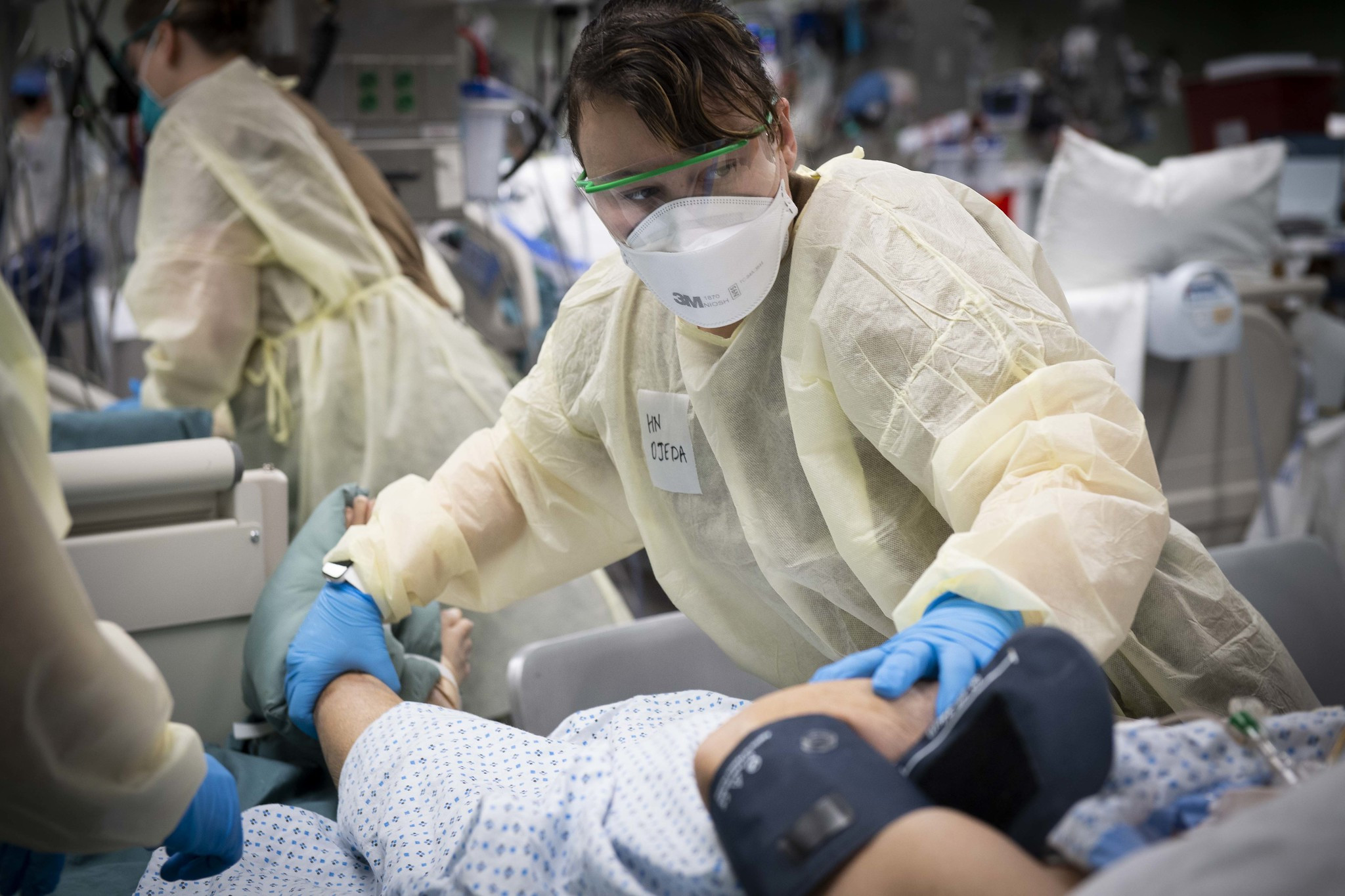
© Navy Medicine, Flickr, 2020
Roger Foley recorded and published excerpts of conversations between himself and medical staff in which the staff present him with the option of assisted dying. Roger describes himself as a young man dying of cerebellum ataxia, a degenerative neurological disease. At the time the recordings were made, he had been living in a London, Ontario, hospital for over two years. Although Roger wanted to live in his own home, he had been refused self-directed government funding that would allow him to do so. Roger presents these recordings as an example of coercion people with disabilities face to seek medical assistance in dying. He contends that the health care system treats medical assistance in dying as the preferred treatment option at the expense of alternatives that would allow people with disabilities like himself to lead assisted lives.
The audio recordings were made in 2018 (and currently available at rogerfoleymusic.com) following the initial legalization of medical assistance in dying in Canada. The recordings drew press coverage in Canada and beyond. They also drew the eye of the UN Human Rights Council's Special Rapporteur on the rights of persons with disabilities. The Special Rapporteur, Catalina Devandas-Aguilar, visited Canada in April 2019. In her report, she highlighted concerns that Canada did not have a protocol requiring that viable alternatives be provided to people with disabilities before medical assistance in dying was approved. The Special Rapporteur recommended that the government investigate allegations that persons with disabilities were being pressured into seeking medical assistance in dying and were seeking the practice because they did not have access to community supports or choices about their care. The Special Rapporteur’s visit to Canada came shortly after the Truchon decision, which found unconstitutional the requirement that natural death be reasonably foreseeable before medical assistance in dying was accessible. In her report, the Special Rapporteur expressed concerns that the Truchon decision would increase pressure on people with disabilities to choose medical assistance in dying because of inadequate supports. Roger went on to testify about his experience of coercion before the House of Commons Standing Committee on Justice and Human Rights. He testified during debates on Bill C-7, which implemented the Truchon decision and expanded medical assistance in dying in Canada.
* Addendum on 30 September 2026:
The two audio recordings Roger Foley made available on his website can be downloaded as MP3 files, each about 2-minutes long. They feature Foley’s voice in conversation with healthcare workers at London Health Sciences Centre, where – as CTV News reports – Foley had ‘been stuck in a hospital bed for more than two years’. One file displays the date ‘Sept1st2017’ and is presented as ‘Hospital Ethicist With Management Soliciting Patient Roger Foley To Have Assisted Dying (Euthanasia)’; the other is dated ‘Jan21st2018’ and described as ‘Hospital Charge Nurse Soliciting Assisted Dying (Euthanasia) To Patient Roger Foley’ (note Foley’s website presents the later recording first). In the 2017 recording, the voice of a man (presumably the ethicist) is heard saying Foley would have to pay to remain in hospital; when Foley asks how much, the man responds, ‘north of $1,500 a day’. Foley retorts that, according to the Ontario health minister, it’s ‘not legal’ to coerce patients into discharge. The man explains he doesn’t use ‘this conversation in every situation’ but ‘only in situations where somebody has a plan in the community that is feasible that they’re not going to accept’ – suggesting there was an outpatient plan Foley should agree to. When Foley expresses shock at the existence of such a plan, made without his knowledge, the man brings up medical assistance in dying (MAiD): ‘Roger, this is not my show. I told you my piece of this was to talk to you about if you had interest in assisted dying’. The 2018 recording reveals a different man (presumably a charge nurse) asking Foley, ‘Are you feeling like you want to harm yourself or anything like that?’. Foley admits he’s ‘always thinking’ about ending his life ‘because of the way things are going’, but immediately adds, ‘if I had self-directed funding, I’d be fine’. Apparently ignoring Foley’s conditional sentence, his interlocutor proposes MAiD: ‘But if you weren’t… you can just apply to get an assisted [sic] if you want to end your life’.
In a 2018 statement, Foley declared he released these recordings because he wanted the public to know ‘the real truth before it is too late for my voice to be heard’. CTV News refers to the files as ‘audio excerpts’, but it is unclear whether they are clippings of longer recordings and whether there are other files; in any case, in 2024 Foley told activist Amanda Achtman that he was offered euthanasia multiple times, indicating the recordings constitute examples of a larger pattern. Though the MP3s appear more as advocacy material than as adjudicated evidence, they reveal hospital staff (not Foley) bringing up MAiD in a context that involves financial considerations – which ethicist Tom Koch found ‘sad and shocking’, and Prof. Tim Staiton considered to ‘present a deeply concerning picture’, as reported by CTV News. However, according to the Canadian Association of MAiD Assessors and Providers, hospital staff can initiate conversations about assisted dying, as long as MAiD is ‘represented as one of the treatment options and not a coercive recommendation to a vulnerable patient’. As specified by Right to Life UK in 2022, Foley ‘secretly recorded’ the conversations; even so, the lack of consent from the hospital staff would not render the files inadmissible in court, as Canada follows a one-party consent rule for audio forensics – and Foley’s voice is in the recordings. The fact that Foley is a musical artist also lends legitimacy to his usage of audio as a familiar medium. The recordings appear in his website under the subheading ‘The Journey’– between a section describing the ‘The Music of Roger Foley’ and one promoting ‘Self-Directed Funding Home Care’ as ‘a model that allows people with disabilities to choose, hire, and manage their own caregivers’. By scrolling through the site’s homepage, one also finds merch to support Foley’s self-directed funding, photos of his musical performances, and prominent audio and videoclip versions of his signature song ‘Limitless with Limitations’. The juxtaposition of the hospital recordings with merch makes them function as another instrument to get Foley closer to his goal of self-directed funding. While we don’t know which audio files have been shared as potential evidence in the lawsuits initiated by Foley, the presence of the MP3s in his website has influenced the court of public opinion.
Roger Foley, ‘File One – Hospital Charge Nurse Soliciting Assisted Dying (Euthanasia) To Patient Roger Foley’, Roger Foley Music, 2017
‘Bringing up Medical Assistance In Dying (MAiD) as a clinical care option’, Canadian Association of MAiD Assessors and Providers (CAMAP), 2022
Bill Gardner
In this blog post, Bill Gardner shares the story of being offered an assisted death as treatment for throat cancer. Drawing on his background as a mental health services researcher, Bill criticizes Canada’s approach to medical assistance in dying as contrary to efforts to prevent suicide and to protect vulnerable people.