© Jane Shi, Bill C-7: An Act to amend the Criminal Code, ArtsEverywhere, 2022
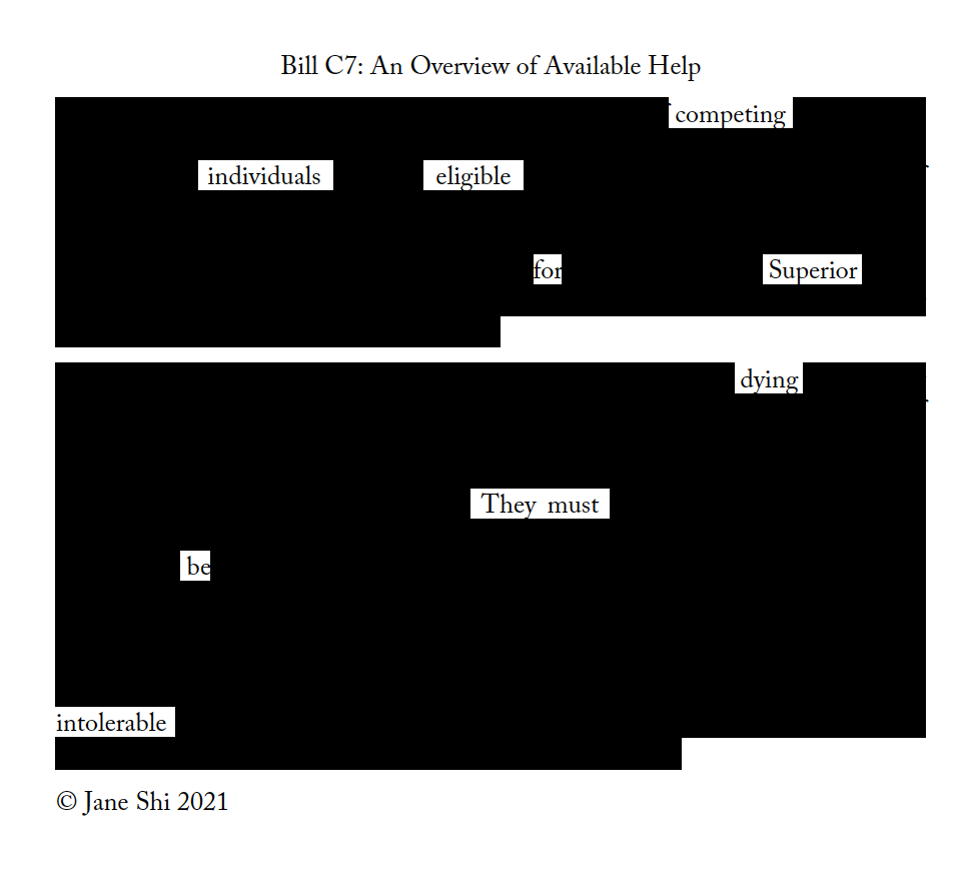
Medical assistance in dying (MAID) has been legal in Canada since 2016, and Bill C-7, passed in 2021, expanded access to persons whose natural death is not reasonably foreseeable but nevertheless suffer from a ‘grevious and irremediable medical condition.’ The potential problems MAID poses for people who are, for example, seriously ill but not dying, old, and have disabilities were flagged from the beginning of discussions around the law. The passage of Bill C-7 thoroughly worried disability communities, who argued that their lives are already negatively affected by ableist assumptions, and that they lack the resources necessary to flourish. A text written by Aislinn Thomas accompanying Shi’s 10-word poem - all words contained in Bill C-7, but differently juxtaposed - observes that ‘most disabled people will tell you, our bodies are not the main source of our suffering. Systemic discrimination and an utter dearth of support is.’ In Shi’s poem, the 'Superior' of the phrase 'Quebec Superior Court' becomes associated with superior people, and the 'intolerable' of 'enduring and intolerable suffering' with disabled people themselves.
The extension of MAID in Canada was brought about by a court case in Quebec in which the two plaintiffs, Nicole Gladu and Jean Truchon, both had debilitating degenerative medical conditions, physical disabilities and wanted to have the option of dying with MAID at their chosen time. Bill C7 was also, for example, supported in the Senate by Senator Chantal Petitclerc, a person with a disability and former Paralympian. Yet disability advocates, including Aislinn Thomas and Jane Shi, have argued that the choices of white, relatively affluent individuals do not reflect the majority of people with disabilities in Canada, who are poor and racialized, and do not have the resources they need to live, much less to thrive. In this view, an intersectional power analysis reveals that the choices associated with the extension of MAID actually serve to perpetuate different forms of oppression.
*Addendum on 28 July 2026:
Published in the ArtsEverywhere platform, Jane Shi’s ‘Bill C7: An Overview of Available Help’ is an erasure poem. The Poetry Foundation defines erasure poetry as ‘a poetic form in which a poet blacks out or in some way erases words from a preexisting source to create new poems’. Using as source the Minister of Justice’s 2021 charter statement titled ‘Bill C-7: An Act to amend the Criminal Code (medical assistance in dying)’, Shi selected the two paragraphs under the subheading ‘Overview’ and proceeded to black out the text. At the end of the process, only 10 words were left – 5 from each paragraph, now turned into stanzas that look like two building blocks with scattered word-windows: ‘competing / individuals / eligible / for / Superior // dying / They must / be / intolerable’. In a 2021 live-stream filibuster organized by Inclusion Canada, Shi offered a close reading of her poem, stating that ‘everyone has the capacity to reclaim and… take the words that are foisted on us and… make it our own’. About the first stanza, Shi said ‘competing’ and ‘Superior’ were striking to her, ‘because [of] the ways that certain kinds of bodies are considered superior in our society’. Shi underscored ‘the way that the government considers who is eligible for what kind of help’ and that ‘this is a very individualizing process… never about the ways that the government has historically and continuously failed communities’. The second stanza – Shi noted – is ‘a reference to the fact that certain bodies are considered intolerable’. Following Shi’s analysis, the panellist Sunny Chiu commented: ‘I really like the way that you cherry-picked the words out of the text, because that’s kind of what the government is doing with us’. Thus, the ‘Overview’ in the title of Shi’s poem gains a different meaning from the ‘Overview’ in the Ministry’s text: while the charter statement claims to scrutinize how the bill impacts human rights, the poem makes us look at how words can be charged, drawing attention to disability rights potentially overlooked by the bill. In a 2013 essay, poet Solmaz Sharif argues that erasure ‘may well be the closest poetry in English has gotten to the role of the state’. Refusing to unwittingly ‘replicate state control’, Sharif lists five tentative political and aesthetic objectives of poetic erasure, including one that Shi’s poem powerfully incarnates: ‘Care for what is left behind so that erasure has an additive or highlighting effect’.
Jane Shi, ‘protect u at all costs’, Arts Everywhere, 2021
Aislinn Thomas, MAID in Canada: A radical response to changes in medically assisted dying, Arts Everywhere, 2021
‘Erasure poetry’, Poetry Foundation, 2024