
© AI, Lexica, 2024
This novella narrates one day in the life of 83-year-old Dutch-born Willem de Wit and his Irish wife Eilis, who is five years younger than he is. They have been married for 56 years and promised each other that they would never put the other in a nursing home, but rather take care of each other at home as long as possible, and provide euthanasia if it were ever to become too much. This pact was triggered by Michael Haneke's film Amour, which Eilis and Willem had seen on television. They made a promise to each other that they would also ‘redeem‘ themselves, as they put it, in a similar situation. And this case has come to pass: Eilis was diagnosed with Alzheimer’s a few years earlier, and her health has deteriorated rapidly since then. Willem kept his promise and has been caring for her for almost two years. He is increasingly overwhelmed, so that throughout the day he keeps thinking about whether he should keep the promise. At the end of the novella, he stands by Eilis' bed with a pillow, ready to kill her, but he drops it at the last moment.
Euthanasia, as Willem and Eilis have promised each other, is not permitted in Switzerland, the author's home country, where only assisted suicide is legal. However, the Novella is set in Ireland, where all forms of assisted dying are prohibited. Willem and Eilis must therefore help each other die alone and outside the law, within the intimate framework of their relationship. Willem's self-sacrificing care for his wife is portrayed in detail, showing not only the physical but also the emotional strain as Eilis' personality increasingly fades due to Alzheimer's disease. A particular burden is the fact that she is no longer able to make a decision, so he alone must decide whether the euthanasia pact is still valid. It is of little help to him that the very condition she was always afraid of has occurred, because he has no reliable clues as to whether she is actually experiencing it as unbearably as she feared. He alone is in a position to decide the value of her existence, which illustrates the problematic nature of euthanasia in cases of advanced dementia. The mutually supportive promise of ‘redemption‘ between Eilis and Willem thus deteriorates into a one-sided, exceedingly heavy burden for him. Why he does not ultimately kill Eilis is not clearly answered in the novella. Willem could either have refrained from doing so out of love, so as not to lose Eilis, for she does have moments when she recognises him and seems happy; or the reason could be his character trait of always shirking responsibility. The ending, typical of novellas, remains open. For Willem himself becomes physically weaker and increasingly forgetful, so that he will soon no longer be able to look after Eilis. This will once again confront him with the question of whether he will put her in a nursing home after all or carry out euthanasia.
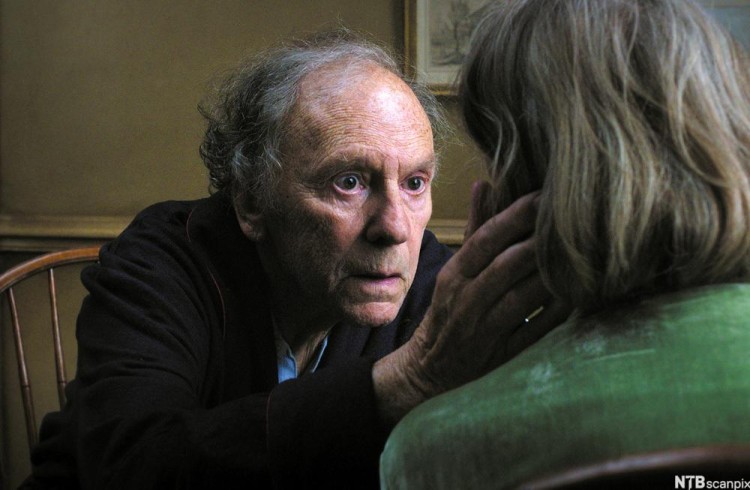
Michael Haneke (director and writer)
Diagnosed with a severe, neurodegenerative condition, Anne steadily declines into a state of near paralysis, leaving her entirely dependent on her husband, Georges, and the carers he employs. Following ever-increasing pressures on Georges, he makes the snap decision to suffocate his wife, in what is presented as a mercy killing, calling us to question the definition of an assisted death.