
‘In memory of Dr. Donald Low’ by Canadian Partnership Against Cancer
- Title ‘In memory of Dr. Donald Low’ by Canadian Partnership Against Cancer
- Author Canadian Partnership Against Cancer
- Year 2013
- Language English
- Tags Beyond the Grave Fear of Being a Burden High Profile Cases Short Video Statement
- Legislative context Criminal Code, 1985, s 241 (Canada)
- Author of entry Jacob Shannon, addendum by Carlos A. Pittella
- First published 01.01.2024
- Last updated 15.10.2026
Donald Low was a Canadian physician and microbiologist widely known in Canada for his work in the 2003 SARS epidemic in Ontario. In his YouTube video, he describes being diagnosed with a brain tumor and coming to terms with the terminal nature of his diagnosis. He outlines how he believes that it is unfortunate that Canada does not permit individuals in situations like his own to seek medical assistance in dying and explains what the procedure looks like in countries that allow the assistance.
Donald Low’s video was released in 2013, before Section 241.2 was added to the Criminal Code in 2016, permitting medical assisted death in certain cases. At the time of his video, conversation on the topic of medical aid in dying was frequent in Canada, and his story was widely circulated and referenced in multiple legal contexts, including by a parliamentarian on the physician-assisted dying parliamentary committee who stated that when his wife, a physician, heard about his committee work, she immediately forwarded him the video. The video would later go on to be referenced by the Ontario Health Minister in a Senate committee, and by Senator Donna Dasko in the third reading of the bill to amend the Canadian Criminal Code to permit medical aid in dying.
* Addendum on 8 September 2026:
With a 7-minute running time, the video ‘In memory of Dr. Donald Low’ was uploaded to YouTube on 4 September 2013 by the Canadian Partnership Against Cancer (CPAC). Created by the federal government as a policy experiment in 2006, CPAC is a nonprofit that, although funded by Health Canada, has worked independently ‘to move Canada’s cancer strategy into action’. Dr. Low’s testimony, containing his plea for assisted dying, was part of ‘The Truth of It’ – a series of videos featuring Canadians who shared their stories about what it is like to have cancer. Low begins by introducing himself as an ‘infectious disease internal medicine physician at Mount Sinai Hospital… diagnosed as having a brain stem tumour’. While the camera remains mostly still, the framing alternates between a medium shot and close-ups of Low – sometimes also cutting to family photos, as if we were privy to an intimate slideshow. Wearing jeans and a blue-striped polo, Low is sitting on a slate-blue couch with a burgundy throw and brown tartan pillows; artwork is visible in the background. Even if his crossed legs and fingers seem relaxed, we are immediately struck by his having one eye closed and the other held open by a piece of medical tape. The video is edited into segments: ‘How will I die?’; ‘Physician-assisted death’; and ‘Hope’. Low’s speaking style is matter-of-fact, conveying the same frank authoritativeness he became known for as a public servant: ‘the prognosis of this type of tumour is bad… And what worries me is how I’m going to die. I’m not afraid of dying… I just don’t want [it] to be a long protracted-out process where I’m unable to carry out my normal bodily functions.’ After mentioning countries where the use of narcotics is accepted to ‘give you a very simple way out’, he declares himself ‘frustrated, not being able to have control of my own life, not being able to make the decision for myself when enough is enough’. He ventures it would ‘be a long time before we mature to a level where we accept dying with dignity’. According to a 2015 piece in Hospital News, ‘for the first time in his life, Dr. Donald Low was wrong’; Low would die 8 days after recording that video, but medical aid in dying would be legalized soon after – by Québec in 2014–2015 and by the federal government in 2015–2016 (see related entries about Manon Brunelle and Sue Rodriguez). Gathering 30,000 views in 1 day, Low’s video played a definite part in the legalization effort – as did his widow, Maureen Taylor, who co-chaired an Expert Advisory Group on Physician-Assisted Dying and was featured in the 2016 CBC documentary Road to Mercy.
Reviews
- ‘SARS Doctor Donald Low’s Posthumous Plea for Assisted Suicide’, CBC News, 2013 → web.archive.org
- Carmen Chai, ‘SARS Doctor Donald Low Urges Canadians to Legalize Assisted Suicide in Posthumous Message’, Global News, 2013 → globalnews.ca
Media citations
- ‘The assisted dying debate: Understanding the Supreme Court ruling’, Hospital News, 2015 → hospitalnews.com
- ‘Widow of Dr. Donald Low lends voice to lift ban on assisted-suicide’, Global News, 2014 → globalnews.ca
- ‘Who owns my life?: Sue Rodriguez changed how we think’, Windsor Star, September 2013 → windsorstar.com
- ‘Dr. Donald Low’s widow to continue end-of-life fight’, CBC News, 26 September 2013 → cbc.ca
- ‘SARS Doctor Donald Low Video Ignites Assisted-Suicide Debate’, CBC News – Your Community Blog, 2013 → web.archive.org
- ‘Dr. Donald Low’s posthumous plea for assisted suicide’, CBC News: The National, 24 September 2013 → youtube.com
Interest Group citations
- ‘Death and Writing: Writing Obituaries, Webinar with Sandra Martin’, Dying with Dignity Canada, 4 November 2021 → dyingwithdignity.ca
- Tony Reid, ‘Reflections from a provider of medical assistance in dying’, Canadian Family Physician Journal, 64(9), 2018 → ncbi.nlm.nih.gov
- ‘At The Heart of Change – 2017 Annual Report’, Dying with Dignity Canada, 2017 → web.archive.org
- ‘Watching someone suffer takes a lot out of loved ones’, Registered Nurses Association of Ontario, March-April 2015 → rnao.ca
- Maureen Taylor & Sandra Martin, ‘Whose Death Is It Anyway? Perspectives on End-of-Life in Canada’, Healthcare Papers Journal, 14(1), 2014 → pubmed.ncbi.nlm.nih.gov
- James E. Read, ‘Dying with Dignity, When people wish to end their lives, should it be legal for physicians to assist them?’, Salvationist, 2013 → salvationist.ca
Legal and Paralegal citations
- Senate of Canada, ‘Bill to Amend—Third Reading—Debate’ (Bill C-7), 16 February 2021 (Hon Donna Dasko) → sencanada.ca
- Maureen Taylor, ‘Brief to the House of Commons Standing Committee on Justice and Human Rights, Bill C-14: An Act to amend the Criminal Code and to make related amendments to other Acts (medical assistance in dying)’, 6 June 2016 → ourcommons.ca
- David Baker, ‘Response to Questions posed by Hon Serge Joyal’ (Brief to Special Joint Committee on Physician-Assisted Dying), 24 February 2016 → ourcommons.ca
- Special Joint Committee on Physician-Assisted Dying, ‘Evidence’, 42-1, no. 5, 26 January 2016 (John Aldag) → parl.ca
- Senate of Canada, ‘Criminal Code | Bill to Amend—Second Reading—Debate Continued’ (Bill S-225), Debates of the Senate, 41-2, vol. 149, no. 118, 18 February 2015 (Hon Josée Verner) → sencanada.ca
- Jennifer Gibson & Maureen Taylor (Co-Chairs), ‘Provincial-Territorial Expert Advisory Group on Physician-Assisted Dying – Final Report’, 30 November 2015 → hss.gov.nt.ca
Related Media
Video Info
Canadian Partnership Against Cancer, ‘In Memory of Dr. Donald Low’, YouTube
- Canadian Partnership Against Cancer, ‘In Memory of Dr. Donald Low’, YouTube youtube.com ↗
- Canadian Partnership Against Cancer, ‘In Memory of Dr. Donald Low’, Cancer View Digest web.archive.org ↗
- Canadian Partnership Against Cancer, ‘The Truth of It Video Series’, CancerView.Ca web.archive.org ↗
- Canadian Partnership Against Cancer, ‘About’, 1 IN 3 web.archive.org ↗
Documentary featuring Low
Nadine Pequeneza (director), Maureen Taylor (contributor), et al., ‘Road to Mercy: Navigating the complexity of medically assisted death in Canada’, CBC Docs – YouTube
- Nadine Pequeneza (director), Maureen Taylor (contributor), et al., ‘Road to Mercy: Navigating the complexity of medically assisted death in Canada’, CBC Docs – YouTube youtube.com ↗
Related Archival Entries
'Manon' by André St-Pierre et al.

André St-Pierre (director), Benoît Dutrizac (interviews), Manon Brunelle (contributor), et al.
The 2004 TV documentary ‘Manon’ chronicles the journey of Manon Brunelle, a Canadian citizen living with multiple sclerosis, as she sought assisted suicide in Switzerland. Her story served as a powerful catalyst for public and political discourse on end-of-life care in Québec, influencing the legislative discussions that led to Bill 52 and to legal medical aid in dying in Canada.
'A Message to the Standing Committee on Justice and Solicitor General' by Sue Rodriguez
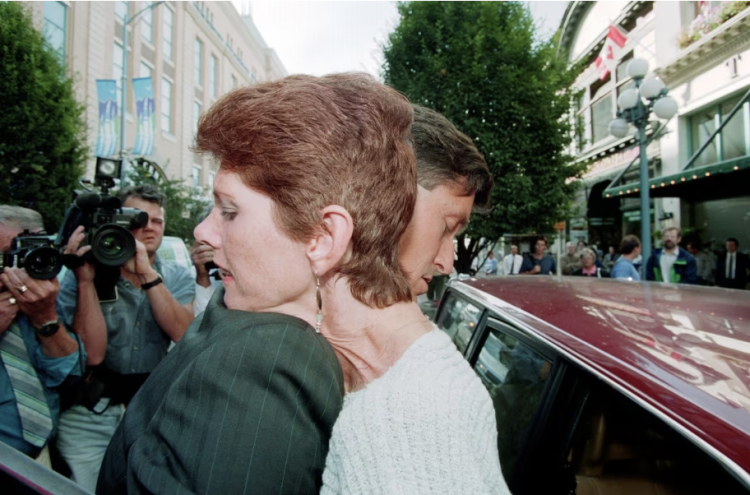
Sue Rodriguez
In this videotaped address to Parliament, Sue Rodriguez, who was dying of ALS and wanted an assisted death, asks ‘If I cannot give consent to my own death […] who owns my life?’ While the Supreme Court of Canada heard her case in 1993 and ultimately decided against her, the publicization of Rodriguez’s story informed much public thinking about assisted dying laws in Canada.
'Dead at Noon' by Gillian Bennett

Gillian Bennett
Gillian Bennett took her own life in 2014, 3 years after being diagnosed with dementia. She posted an open letter online explaining her reasons and hoping to reignite the debate about assisted dying in Canada. The law changed soon after.