
© Udo Ockema, Muntflats in Heerenveen, Wikimedia Commons, 2007
The mother of documentary filmmaker Elena Lindemans struggled with severe psychological suffering. During her marriage to Elena’s father, the family – according to Lindemans – was terrorized for years by his mistress, who also had a child with him. Elena’s mother experienced anxiety, chronic stress, panic attacks, and physical tension. Eventually, the marriage ended. Elena’s mother was hospitalized multiple times and treated by numerous healthcare professionals. When she requested for euthanasia, this request was not considered by the doctors who believed it did not meet the legal criteria. For this reason, Elena’s mother decided to end her own life. She did this by jumping from a high-rise building in 2002. In the documentary Moeders springen niet van flats, Lindemans talks to residents of the building who still remember the suicide. She asks them about the impact the suicide had on them and shares her own feelings and thoughts. Additionally, Lindemans reminisces about the suicide with her sister and later partner Ed and speaks with several doctors about their considerations.
Through a personal story, the documentary portrays the dilemmas that can arise in decision-making regarding medically assisted suicide for psychological suffering. Elena’s mother’s general practitioner explicitly states that he was not ready in 2002 to cooperate with euthanasia for severe psychological suffering: he saw possibilities for improvement and also feared a confrontation with the judiciary. Now, he might have performed euthanasia. In contrast, a psychiatrist maintains the view that Elena’s mother did not meet all the criteria for euthanasia, as there were still treatment options available. Lindemans also powerfully shows the impact her mother’s suicide had on the residents of the high-rise who witnessed it. Their reactions reinforce Lindemans’ belief that solitary suicide is a distinctly undignified end of life: for the person committing suicide, their survivors, and accidental witnesses. She contrasts this with the dignified death she believes could have been possible if euthanasia had been allowed. The documentary serves as a denunciation of the fact that euthanasia for psychological suffering was granted in relatively few cases at the time the film was made, despite the possibility under Dutch law since 2002. Lindemans also conveyed this message during a parliamentary hearing in 2014, and in 2024 made a documentary series called Een goede dood (A good death). In this series, Lindemans follows six people who are severely suffering mentally and want to have control over their end of life.
* Addendum on October 19, 2026:
Moeders springen niet van flats employs a restrained aesthetic to place a deeply personal inquiry – a daughter’s investigation into her mother’s suicide – within a broader critique of Dutch policy on assisted dying for psychological suffering. This approach is established early on, when the camera slowly descends the façade of the apartment building from which Lindemans’s mother jumped. The movement not only evokes the fall itself, but it also presents the building as a home to many residents. Windows that face outward and expose fragments of people’s homes signal from the start that the death had an audience. This anticipates the witnesses Lindemans tracks down, whose accounts widen the film’s concern beyond a single family.
The film’s recurring concern with preserving individual autonomy is reinforced by its reliance on intimate close-ups. Rarely does the frame contain more than one subject, even during conversation, which allows the camera to register each person’s reaction as Lindemans recounts her story. The viewer observes how faces soften, eyes fill with tears, and brows furrow. This immediacy produces a strong emotional effect, one that is most evident in the encounter with a woman who witnessed, from a nearby building, Lindemans’s mother’s fall. Unaware of the exact circumstances of Lindemans’s mother’s death, the woman in question linked the memory to frustration and anger at the harm the tragic fall caused those who witnessed it. When Lindemans reveals that the family knew her mother’s intentions and chose to ‘let her go’ because no other option remained, the close-up of the woman’s face registers a visible emotional softening. This framing recurs with other residents who learn the circumstances of the case. Like Lindemans, the witnesses receive answers to questions that had long remained unresolved. By registering these – at times – emotional responses, Lindemans draws attention to the lack of dignity of the death sought by a woman whose request for help had been refused. This visual strategy can be read as a plea to reconsider Netherlands’ approach to assisted dying for psychological suffering. By seeking answers from those directly and indirectly affected by her mother’s death, Lindemans underlines that denying that option impacts far more people than one would think. While the intimate close-ups underscore the theme of autonomy, Lindemans’s sustained interest in the witnesses’ experiences and stories suggests that the issue must also be understood as a relational one.
The same technique of intimate close-ups governs the interviews with the doctors who denied her mother’s request for euthanasia. Here, the camera often remains in close-up on Lindemans herself, so that her gradual uncovering of answers is conveyed through her own reactions rather than through experts’ explanations. The documentary reaches a subtle catharsis when Lindemans revisits her mother’s former physician, who now recognizes that ‘sometimes, helping means stopping the treatment and respecting the person’s autonomy’. In this manner, Lindemans has collected answers but also generated new questions. A potent close-up captures Lindemans’s disbelief when her mother’s former psychiatrist admits to her that he was never informed of her mother’s suicide: ‘would you not be performing your job in a better way if you kept up with the outcomes of patients whose requests you denied?’ Through her effective blend of personal inquiry and journalistic investigation, Lindemans humanizes and exposes the shortcomings in Dutch policies and procedures governing euthanasia requests for psychological suffering (see related Assisted Lab entries on Levenseindekliniek and Witte Flits).
The film’s unembellished style, supported by a serene score, slow cuts, and desaturation of colour tones, allows its content to carry the emotional weight and leaves space for the audience to reflect. The calm piano score largely recedes during dialogue, giving the audience space for reflection. The most striking sonic choice occurs when Lindemans hesitantly steps onto the eleventh-floor balcony and all sound drops out for a few seconds, including the wind, the rain, and the noisy highway. Because ambient noise is not removed elsewhere in the film, this momentary silence feels deliberate: in her search to retrace her mother’s steps that led to that day in February 2002, the ones leading to the balcony demand complete silence.
In Moeders springen niet van flats, restraint is itself the argument: instead of explicitly calling for reform of the Netherlands’ policy on assisted dying for psychological suffering, the film interviews people indirectly affected by the death of Lindemans’s mother, showing the audience that a system refusing help to those in psychological pain fails not only the person who sought it, but also everyone who is then involuntarily implicated in her undignified death.
Elena Lindemans (director), Een goede dood, 2024
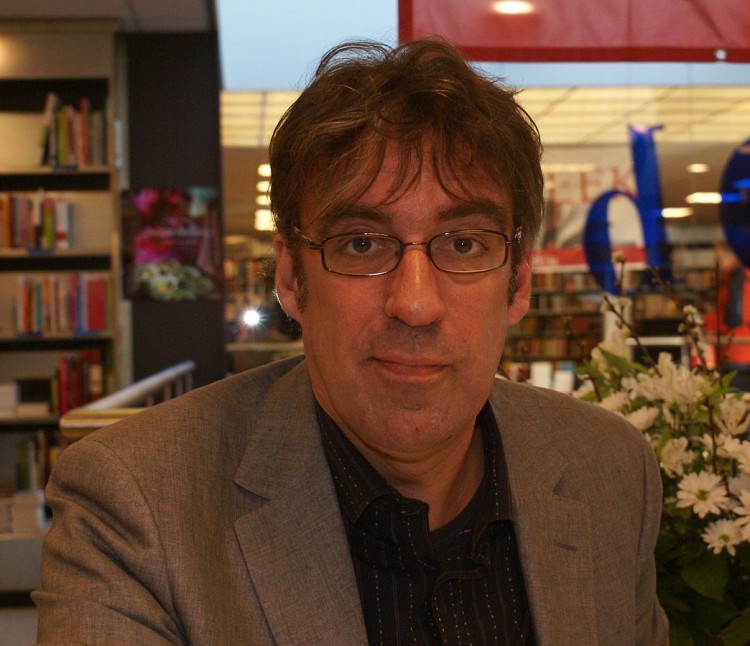
Joost Zwagerman
In this book of essays and interviews on suicide, writer Joost Zwagerman argues that medically assisted dying for psychological reasons is unwarranted. The author, who took his own life in 2015, has been a prominent voice in Dutch discourse surrounding this issue.
Marcel Ouddeken and Hans Kema (directors)
The documentary film ‘Levenseindekliniek’ revolves around the Dutch End-of-Life Clinic, an organization that specifically deals with patients whose euthanasia requests are complex. The film follows three patients who have requested euthanasia at the End-of-Life Clinic because their own doctors were not willing to proceed with euthanasia.

Laura Hermanides (director and writer), Roelof Jan Minneboo (writer)
Rick has been suffering from severe psychological issues for twenty years. His persistent wish not to live any longer is acknowledged by a psychiatrist, who assists with his suicide. Rick is actively supported by his parents, who come to recognize the hopelessness of their son’s situation.