© Alatele.fr, Flickr, 2015
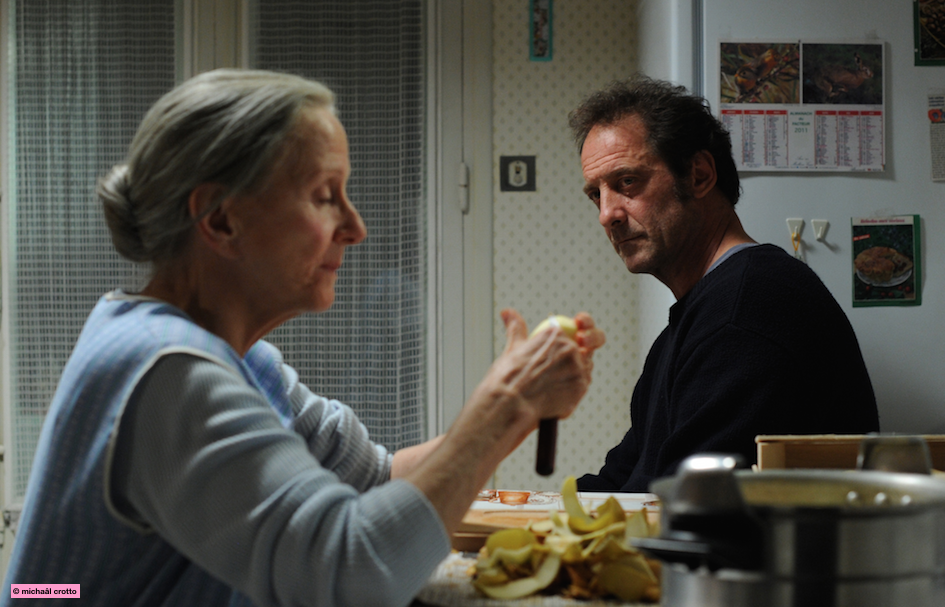
This fictional film centres on the relationship between Alain and his elderly mother, Yvette. When Alain is released from prison, he goes to live with his mother. The relationship is tense from the outset, with Yvette regularly reminding her son that this is not his home and, therefore, he cannot do as he pleases. In return, Alain is often aggressive and threatens violence towards his mother. In this tense environment, Alain discovers papers relating to his mother’s wish to have an assisted death with the help of the Swiss association, Voluntas (a clear allusion to Dignitas). Although he is initially hesitant, as he comes to realise the extent of his mother’s cancer, the two begin to restore their relationship, and he agrees to support her. Alain and Yvette travel to Switzerland together and Alain remains with his mother until the end. When she drinks the cocktail of drugs that will end her life, however, there is a moment of high emotion as the two are reconciled once and for all, when Yvette tells him that she loves him and he her. From this moment, it seems that there is a new sense of purpose in Alain’s life and the film closes on a decidedly optimistic note.
The film juxtaposes Alain’s new life outside of prison with his mother’s looming exit from life. As Yvette’s health declines, the medical monitoring of her condition becomes an aesthetic feature in its own right: we see CCTV footage of her entering a scanner, followed by close-up shots that depict her mid-scan, dressed in a hospital gown, with a mesh mask over her face, while the repetitive sounds of the scanner dominate. Sound also plays an important role in the home environment, where silence is a frequent companion to Alain and his mother’s shared living, often juxtaposed with scenes where music accompanies Alain enjoying life with his friends and eventual lover. These frequent silences within the home are interrupted only by competing television and radio noise, or by heated arguments, which illustrate the underlying tensions between mother and son. Visually, the home is depicted in sombre tones, which are sharply contrasted with the vibrancy of the scenes that take place beyond it, amplifying this tense, brooding atmosphere. The contrast between light and dark becomes more pronounced still when Alain drives his mother to light, airy Switzerland, where the viewer cannot help but be struck by the brightness of the Voluntas house. As Alain and his mother travel in the car, the Swiss landscape is depicted idyllically, with views of impressive mountains, bright blue sky and vibrant green vegetation accompanied by birds chirping sweetly in the trees. As with other works that address suicide tourism, this imagery reinforces stereotypical ideas about Switzerland as an idyllic place to end one’s life, both in terms of scenery and the legal framework that permits assisted dying. It is here, on Yvette’s deathbed, that the silence between mother and son is finally broken by her tears, by her admission of love for her son, and by Alain’s reciprocation. In turn, silence is gently replaced by music, symbolic of Alain’s new life, now changed by this experience with his mother.
Brizé’s film explores many of the issues that affect French citizens travelling to Switzerland in search of an assisted death, from the medical to the social to the legal implications of the decision. In this sense, it seeks to offer a rounded perspective on the experience of assisted dying for a French citizen who chooses to die in Switzerland. The film also highlights the role of associations like Dignitas in supporting non-Swiss citizens to end their lives in the country, focusing particularly on the checks and balances that exist to ensure that an assisted death is the patient’s own wish and that they are not under any duress from relatives or friends. What emerges strongly in the film is the importance of supportive relationships at the end of life, whether they be with family and friends or complete strangers (in the form of volunteers from an assisted dying association). The film was cited in debates regarding Olivier Falorni’s ‘Proposition de loi donnant le droit à une fin de vie libre et choisie’ (2021) and featured in the bibliography provided to members of France’s Convention citoyenne sur la fin de vie.