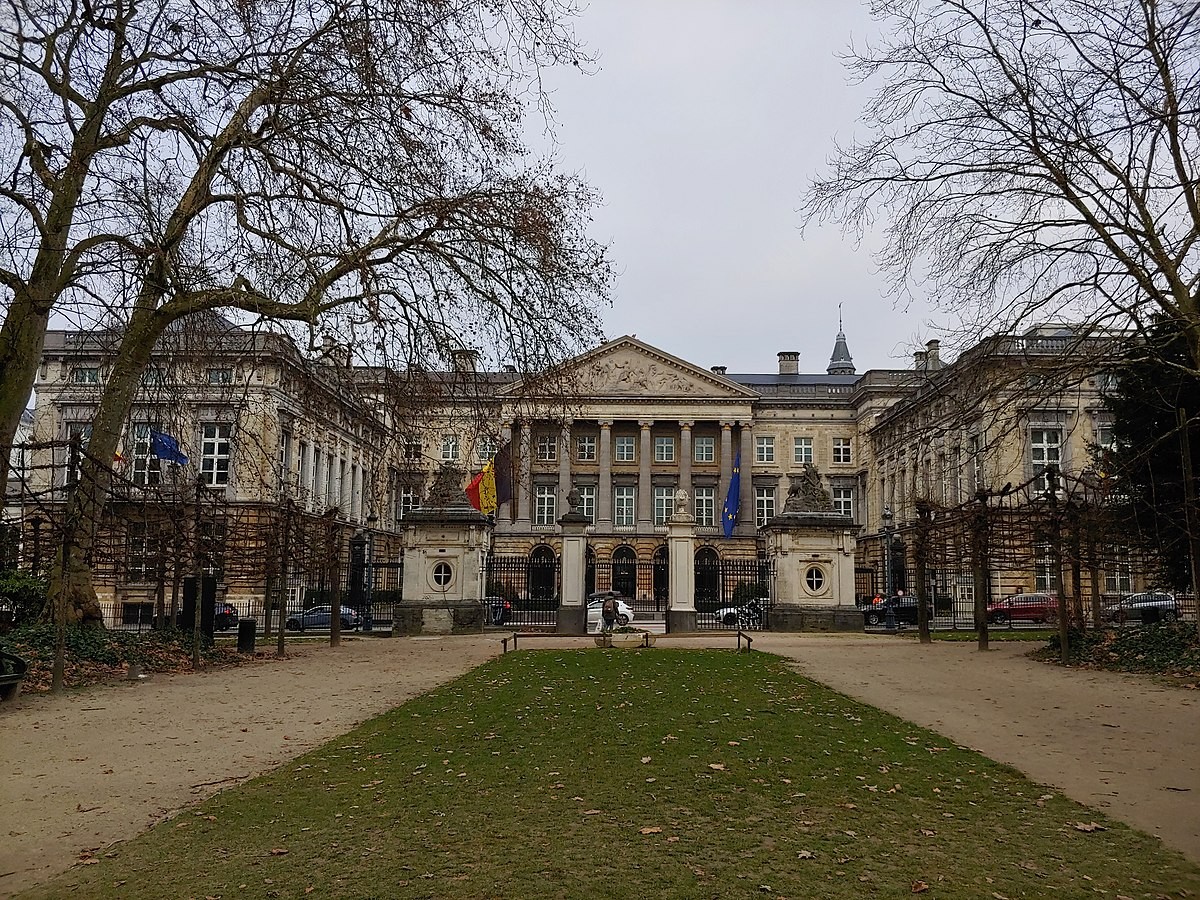
© Jaronax, The Belgian Senate, Wikimedia Commons, 2021
Tot altijd tells the story of Mario Verstraete, a Flemish man whose life – in the 1980s and 1990s – initially unfolds quite ordinary. He marries, has a son, and divorces. In 1995 he goes to his general practitioner and good friend Thomas with eye complaints. Thomas refers him to a neurologist. Mario turns out to have multiple sclerosis, and his condition deteriorates over the course of several years. Not only does he struggle with physical issues, but he also experiences mental decline. Mario joins the advocacy group Waardig sterven (Dignity in Dying), that makes a case for the legalization of euthanasia and medically assisted suicide in Belgium. Mario writes an opinion piece in a newspaper advocating for the importance of dying with dignity at a self-chosen moment and gives a personal testimony in the Belgian Senate. Eventually, in 2002, the euthanasia law is passed and comes into effect within the same year. Just a week after the law’s implementation, Mario dies by medically assisted suicide.
Although the film contains some historical footage of the proceedings in the Belgian Senate, Tot altijd offers a fictionalized and dramatized version of Mario Verstraete’s life. It connects his personal history with the Belgian legislative trajectory regarding euthanasia and assisted suicide (see related Assisted Lab entries on the novel Los and the documentary Marieke, addicted to life). At the beginning of the film, Mario is shown protesting against cruise missiles in the 1980s; that same activist attitude characterizes his involvement in medically assisted suicide. While the film primarily highlights Mario and his supporters’ viewpoints and arguments (focusing on autonomy and the freedom to choose), it also explores other perspectives. Mario’s father represents the religious standpoint that life is sacred and humans should not have unrestricted control over it. Mario’s close friend and physician, Thomas, grapples throughout the film with Mario’s stance. Thomas holds a different opinion on the role of doctors, believing they should serve life. Contrasting Thomas’s professional view is doctor Frank Valaeys, a vocal advocate for euthanasia and assisted suicide. Valaeys uses the comparison of ‘dying like a dog’ to describe the negative consequences of not having the option of medically assisted suicide, while Thomas himself has expressed the fear that his son might end up with ‘a vegetable for a father.’ These negative figurative expressions are accompanied by a reflection on the role of medical technology that prolongs people’s lives in the twentieth century. The film provides a good impression of the Belgian legislative process, the arguments used in that process, and the role of Mario Verstraete. The connection with reality is further explored in a book of the same name released concurrently with the film. This book emphasizes the value of euthanasia as represented in Tot altijd. The film has been referred to in positive ways by advocates of euthanasia, such as noted euthanasia physician and professor Wim Distelmans, but has also been shown at debate nights about euthanasia (e.g., the disABILITY film festival in Leuven, 2019). Critical comments could also be heard: for example, the MS League Flanders argued that the film’s link between multiple sclerosis and euthanasia caused many patients to have a sense of doubt about their quality of life. Tot altijd was adapted for theatre in 2024.
* Addendum on October 21, 2026:
In Nic Balthazar’s Tot Altijd (2012), the mobility of the camera mirrors the physical decline of its protagonist, Mario Verstraeten. The feature’s first fifteen minutes, set in the late 1980s and well before Mario’s multiple sclerosis diagnosis, are edited with rapid, energetic cuts. Handheld cameras keep pace with Mario and his friends protesting American cruise missiles. When Mario bravely leaps onto an American army vehicle, the camera follows his every agile move. Later, when he runs for city council, the camera trails his friends as they celebrate and mock his election posters, again moving freely with the bodies on screen. After Mario receives his MS diagnosis, the pace of the cuts slows down and the film’s colour tone turns less saturated. As Mario becomes more dependent on his wheelchair, scenes are shot on a dolly, a technique that can match his wheelchair’s steady, carefully controlled, and generally slower pace. As Mario loses physical mobility, so does the camera. Toward the end of the film, when Mario’s symptoms prevent him from sitting upright and sequester him to a sofa, the cinematography gives way entirely to fixed, immobile frames. The viewer, like Mario, becomes trapped into close-ups.
In the short documentary Tot Altijd: The Making Of accompanying the feature film, cinematographer Alexander Decommere confirms that the camera’s mirroring of Mario’s illness was a deliberate choice. He describes the film’s opening, with its images of Mario’s activist youth, as ‘Woodstock-esque’ to underline Mario’s rambunctious spirit and vitality. Director Nic Balthazar explains that, because the film follows and timestamps the progression of Mario’s illness and its aggravating physical and cognitive symptoms, the filming shifts from supple handheld shots to tracking shots, which are more fixed in trajectory and therefore less mobile. For the film’s final scene, in which his loved ones say their farewells at the site where Mario’s ashes are spread, the camera shifts to wide shots positioned from above. Balthazar explains that these wide frames invite the audience into a moment of reflection and silence. Throughout the film, lighthearted humour and quips had regularly served to offset the seriousness of the subject matter, so the final scene stands in deliberate contrast: sombre, quiet and still.
The cinematography’s increasingly restricted camera movement draws the audience into Mario’s perspective. As the frames narrow and the pace slows, the viewer is made to share, rather than merely observe, his frustration at a previously healthy and reliable body that no longer cooperates. Mario’s frustration at his realization of this impending fate surfaces explicitly in the restaurant scene, when Mario has lunch with his friend and physician Thomas. Still processing his diagnosis, Mario confesses: ‘I left the house today and thought, surely the world must have stopped turning? I have MS, I have multiple sclerosis – everything must stop now for a while! But no, everything just continues. People go about their day, laughing’ (translated from the original Flemish). In this pivotal scene, Mario expresses his anger towards the incomprehensible difference between a world that carries on at its usual pace and his own, which is about to slow down and become more restricted. Around the time of this scene, the camera’s movements begin to enact that contrast. Where the film’s opening scenes moved freely with Mario’s healthy body, the camera now holds still, and the viewer is made to feel the stillness he describes while everything around him just continues.
Nic Balthazar, Marijke Libert, and Mia Verstraete, Tot altijd. Over de keuze van Mario Verstraete en het euthanasiedebat vandaag (Tielt: Lannoo, 2012)
Nic Balthazar, Marijke Libert, and Mia Verstraete, Tot altijd. Over de keuze van Mario Verstraete en het euthanasiedebat vandaag (Tielt: Lannoo, 2012)
Manu Jacobs (director), Tot Altijd (theatrical adaptation), 2024
Tom Naegels
Antwerp journalist Tom’s grandfather, Bob, has cancer and would like to receive euthanasia. However, he does not meet the criteria of hopeless and unbearable suffering set by Belgian law. Although Tom and his mother advocate for Bob’s right to self-determination, this has little effect. The novel provides a critical reflection of the criteria outlined in Belgian euthanasia law.

Pola Rapaport (director)
The Belgian wheelchair athlete Marieke Vervoort suffered from progressive myelopathy, a rare degenerative muscle disease. The winner of multiple medals at the 2012 and 2016 Paralympic Games experienced increasingly unbearable pain and chose to pass away through euthanasia in 2019, which is presented in a positive light. As a public figure, her case sparked widespread debate in the media.