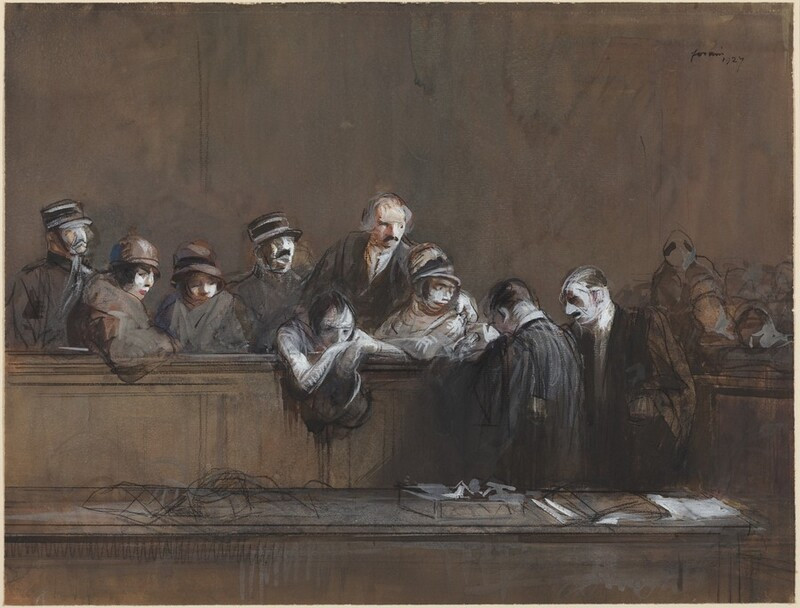
Jean-Louis Forain, court scene, 1927
A 59-year-old white-haired man, wearing a knit sweater and ochre blazer, sits on a chair, alone on the stage. Behind him, a full-wall screen shows a video of driving at night – we follow a dark road as if we were in a car and the headlights were our eyes. In the background, a flamenco guitar strums a foreboding theme. The man starts telling a story: ‘On the morning of March 29, 2005, my life changed radically, but I didn’t know it yet… The woman I killed was named Carmen. She was 82 years old. Even if I hadn’t made that decision, she, Carmen, was dead. I pleaded guilty to avoid going to jail. But there was no trial, there was a deal. I didn’t have the chance to explain myself; and the jury couldn’t reach a verdict. That’s why I’d like you to judge me tonight… My name is Marcos Ariel Hourmann, and I’m not an actor; I’m a doctor – the first doctor convicted in Spain for practicing euthanasia’ (translated from Spanish, as all other quotes, unless otherwise noted). This is the trailer for the play Celebraré mi muerte (I will celebrate my death), co-written by Alberto San Juan and Víctor Morilla (also co-directors), as well as by Hourmann, who tells his story as a plain-spoken monologue aided by images, then invites the audience to deliberate and pass judgment on his actions. The facts have been widely reported: an Argentinian expat working on emergency care in Spain in 2005, Dr. Hourmann attended to 82-year-old Carmen, who was brought to the hospital in critical condition: heart attack and gastrointestinal hemorrhage as terminal developments of a colon cancer. Carmen, who was accompanied by her daughter, asked Hourmann to let her die right away, but he still treated her – until there was nothing else to be done, as her clinical situation was irreversible. He explained to the daughter they could only sedate Carmen, but the daughter asked him to help her mother die. Hourmann states he remembered his own father’s terminal suffering and identified with the patient’s daughter – as if, in that moment, Carmen was also his parent. So, he administered a potassium chloride injection to Carmen, which caused her death by cardiovascular arrest. Hourmann knew the only authorized protocol was palliative sedation. Even though there are hush-hush stories of doctors’ helping patients die outside the law, Hourmann felt he had nothing to hide – so he registered the procedure in Carmen’s medical record. That note became the main piece of evidence in the legal and public-opinion trials that ensued.
Dr. Hourmann’s story has been told both with and without his involvement. The first version appeared in 2010, under the sensationalist headline ‘Killer doc worked in UK hospital’, in the British tabloid The Sun. Hourmann then undertook various initiatives to regain narrative control. Besides the play, notable iterations of his account include the self-published 2017 memoir Morir viviendo, vivir muriendo (To die living, to live dying) and the 2026 episode ‘Historia clínica’ (Medical record) of the investigative podcast Radio Ambulante, which features long segments of interviews with the doctor. If the book (now out of print) informed the play, the podcast may be the closest one can get to being in the audience without going to the theatre. Since the performance is interactive, there are no recordings available online, in order to protect the privacy of the participants. Multiple critics call attention to the play’s unadorned language and expression, deeming it ‘completely natural, as if he [Hourmann] were narrating the events to a group of friends’ (Espetáculos BCN, translated from Catalan), and ‘stripped of vehemence, of ponderous metaphors… whereas the only thing that matters are the facts’ (Mi reino por un caballo). This commitment to cold reporting seems more than a stylistic choice, having also ethical reverberations. Reviewers note that the work doesn’t come across as a defence of euthanasia, but rather ‘as a documentary, [presenting] positions both against and in favor of euthanasia’ (En Platea) and generating ‘more questions than affirmations’ (elDiario). At the end of Hourmann’s monologue, the audience becomes the jury, responsible for delivering innocent-or-guilty verdicts and optional written notes to the doctor, who reads some of them out loud. As is the nature of theatre – all the more so in interactive plays – every performance is different, and there are days when the judgement hits harder, as reports El País: ‘At the end of a Saturday show, after the verdict, Hourmann was visibly disconcerted’ and unable to read the comments aloud or to complete the vote tally. To an interviewer who asked Hourmann how it feels to relive on stage the greatest dilemma he experienced as a doctor, he answered his ‘first sensation is happiness… because [he] learned to know and listen to the silence, and this silence… makes [him] feel that people are completely focused on what they listen… and every time is like the first time’ (La Clem Cultura).
In an interview with Infobae, Hourmann stated that, in Spain, the reception of the play echoes society, with 85-90% of the verdicts being in favour of euthanasia (for comparison, a 2021 poll from the Centro de Investigaciones Sociológicas found that 72% of citizens favoured the legality of the procedure; Ferdinand von Schirach’s contemporary play GOTT, also reviewed by Assisted Lab, has tallied 62% of ‘yes’ to-date). Between Carmen’s assisted death in 2005 and the play’s run from 2019 to 2023, Spain’s legal landscape changed – but not without turmoil for Hourmann. Carmen’s family always stood by him, but the hospital where Carmen died fired and sued the doctor, interpreting his clinical note as an admission of guilt. While Hourmann maintains he never regretted his deed, he made a deal with the prosecutors in 2009, pleading guilty to manslaughter to avoid going to jail – and having to pay a €1600 fine, plus serve one year in conditional liberty (sentence 110/2009 from Tarragona’s Provincial Audience details the case while referring to Hourmann as ‘Alexis’, a fictitious name). No longer able to find employment in Spain, Hourmann moved with his family to the UK, where The Sun exploited his story. This led to his being fired again, because Hourmann had failed to disclose his criminal case to UK employers (a 2010 briefing by UK Health Regulators informs he was suspended from the General Medical Council’s registry due to ‘Dr H’s history and potential threat to patient safety’). When Spain approved Organic Law 3/2021 regulating euthanasia, Hourmann’s play – then already being staged for 2 years – was not changed, as reports La Vanguardia: ‘Although the public debate has evolved, Celebraré mi muerte speaks of the situation and the struggle to achieve this law’. The theatrical piece has been promoted by groups such as Luto in Colores, an educational project dedicated to breaking the taboos surrounding death, and the Derecho a Morir Dignamente association, which has also organized events with Hourmann. Like the story of Colombian poet Carlos Framb, popularized by the memoir Del otro lado del jardín and a homonymous film (see related Assisted Lab entries), the legal citations precede the cultural objects that helped spread the stories; and yet, the stories go beyond their initial jurisdictions. Hourmann’s chronicle became entwined with the saga of Spain’s euthanasia reform, but also serves as a reminder that in Hourmann’s birth country of Argentina, where the play was also staged, assisted dying remains illegal.
‘Celebraré mi muerte – Sinopsis’ [Play Synopsis], Teatro del Barrio
[Memoir] Marcos Ariel Hourmann, ‘Morir viviendo vivir muriendo’ [self-published]
‘Historia Clínica’ – season 15, episode 35, Radio Ambulante

Ferdinand von Schirach
After the death of his wife, 78-year-old Richard Gärtner wants to end his life by assisted suicide, although he is in perfect health. In the form of a meeting of the German Ethics Council, the play questions whether it is ethically justifiable for a doctor to help a healthy person take their own life and lets the audience vote on it.
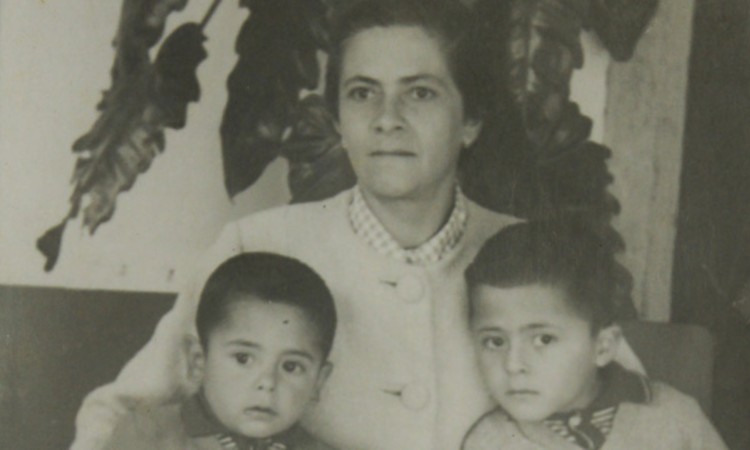
Carlos Framb
After assisting in his mother Luzmila Alzate’s death in 2007 and unsuccessfully attempting suicide, the poet Carlos Framb found himself accused of homicide. This memoir recounts Framb’s legal saga, his relationship with his mother, and defends the right-to-die in the context of Colombia, that had decriminalized euthanasia in 1997 but not yet created guidelines for assisted dying.

Daniel Posada (director and screenwriter), Ignacio del Moral (screenwriter)
The poet Carlos Framb wakes in a hospital bed, handcuffed and accused of homicide. He had attempted suicide after assisting his mother Luzmila Alzate to die, which he claims was an act of love. Inspired by Framb’s 2009 memoir by the same title, but with notable differences, this 2024 film turns a real story into a courtroom drama about the individual rights to death and to abortion.