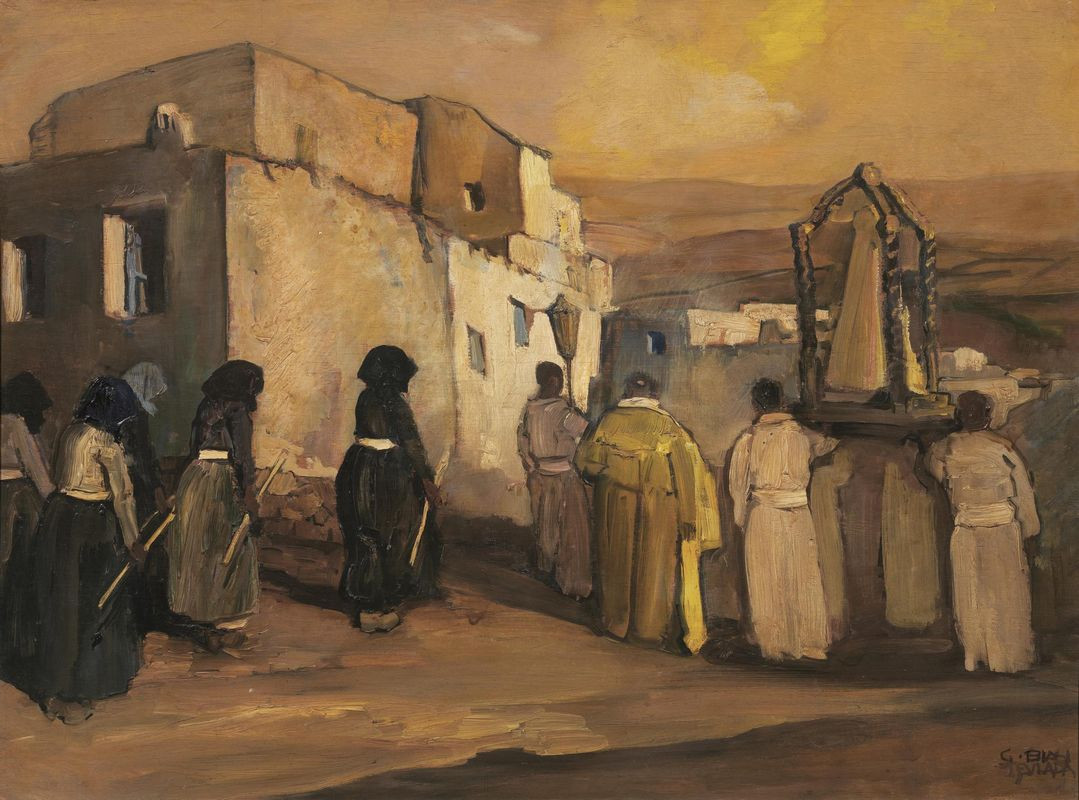
Giuseppe Biasi, ‘Processione’, c. 1919
Michela Murgia’s 2009 novel Accabadora opens with a definition: ‘Fillus de anima’ (soul child). ‘That’s what they call children born twice, by the poverty of one woman and the sterility of another’ (translated from the Italian, as all other quotes, unless noted otherwise). The protagonist is Maria Listru, the fourth biological daughter of Anna Teresa Listru and soul-child of Bonaria Urrai, aka Tzia Bonaria, whom we soon learn is the title character. From the Spanish verb ‘acabar’, ‘accabadora’ means ‘the one who finishes’ – an angel of mercy that helps end the suffering of the dying in Sardinian folktales. The story takes place in the fictional village of Soreni, but in the historical post-war of 1950s Sardinia. Though not strictly ‘war widows’, the fates of Maria’s two mothers are linked to WWII: since Anna Teresa’s husband did not die in war (but in a freak accident with a tractor), she receives no pension; and Bonaria never got to marry, as her fiancé did not return from combat. When Bonaria brings Maria to her new home, the child thinks her adoptive mother is a seamstress. Indeed, Maria learns that trade from Bonaria, who also insists that Maria assiduously attend school. Maria and her teacher Luciana (who is from Turin) seem to be the only ones unaware of Bonaria’s other occupation. But Maria starts to grow suspicious, as Bonaria occasionally sneaks out in the middle of the night. In one such departure, Bonaria is called to end the suffering of Jusepi Vargiu, who, according to his daughter, has been ill for 2 years, immobile for almost 8 months, and uncommunicative for more than a week. Yet, when left alone with the supposed moribund, Bonaria finds out he still speaks; she refuses to help him die and curses the family for lying and wanting to dispose of their father before his hour. If Bonaria’s due-diligence criteria seem clear, they will be challenged by Nicola Bastíu, who had his leg amputated and now wants to die: he is young, not terminally ill, and doesn’t have the blessing of his family. He asks Bonaria for help anyway, as he feels he is already dead. She challenges his equating being a man with having both legs but eventually acquiesces, because Nicola’s resolve reminds Bonaria of her own long-lost love, who once said he would prefer to die than live mutilated. When Maria finds out Bonaria is the accabadora, she leaves her soul-mother to become a live-in nanny for a family in Turin. After Bonaria has a stroke, Maria rushes back home to care for her, discovering firsthand how much suffering is too much to witness.
Despite the novel’s well-known portrayal of euthanasia, Murgia told Socrem Bologna that her original motivation was to write about soul-filiation, the traditional Sardinian practice of informal adoption. Crooked Timber reports that, as a teenager, Murgia herself was taken in by another family as a soul-child. The novel opens with a dedication that plays with the number-agreement of the word ‘mother’: ‘To my mother. Both of them’ (sic). A reviewer for Le Idi di highlights how the role of women in a patriarchal society drives the narrative – through the invisible labour of mothering and the formation of unorthodox families. When Maria accuses Bonaria of rushing death because things should be left alone, Bonaria replies: ‘Were you by any chance born alone, Maria? Did you leave your mother’s womb by your own strength? Or weren’t you instead born with someone’s help, like all the living?’ Bonaria then states that, even if her ‘womb was never opened’, she has a role to play – ‘the last one… the last mother some have seen’. Thus, Murgia links mothering to the labour of giving not only birth but also death. ‘Labour’ connotes hard, grinding work – and things move slowly in the novel, as 1stBookReview asserts, ‘matching the slow pace of rural Sardinian life in the fifties’ and amplifying ‘the heavy weight of silence’ (originally in English). To balance such weight, the short chapters, the overall concision (164 pages in total), plus the frequent use of colorful dialect add up to an efficient rhythm, neither too heavy nor too light. As a critic from Il Borgo dei fogli puts it, while the theme remains heavy, the novel doesn’t make us feel weighed down (see the related Assisted Lab entry about a Tomás González novel that also plays with slowing down time). Although The Times calls the plot ‘simple’, the story doesn’t always move linearly. Key revelations of character motives emerge as flashbacks: why Bonaria never married, why she adopted Maria, and why she believes she must help someone die when ‘the unlawful act would be doing nothing’. This last flashback is the closest we get to an origin story: a young Bonaria witnesses a post-partum complication and the women assisting the birth are unable to stop the new mother’s hemorrhage, so they consider helping end her suffering. It’s only when Nicola requests her help that Bonaria questions if she is still capable of ‘distinguishing between mercy and crime’ – and their debate calls to mind Ramón Sampedro’s treatise on the ethics of euthanasia (see related Assisted Lab entry on Sampedro’s memoir).
The Times argues that Murgia’s recovery of the Sardinian legend at a time when Italy was reassessing its history (in the context of the 150th anniversary of Italy’s unification) was responsible for the book’s appeal – leading to its being translated into dozens of languages and snatching 7 literary prizes, including the prestigious Premio Campiello. In fact, during the Campiello award ceremony, the jury’s president declared that ‘the faith in writing as a tool for recovering and reclaiming our past has won’. Yet, the very question of whether the accabadora really existed remains unsettled, because her work would have been done in secrecy – only men were sanctioned to kill, and the Church monopolized the power over life and death. According to scholars Gina Miele and Christina Welch cited in Atlas Obscura, this could explain why, on one hand, the accabadora’s ‘killings were seen as socially good deaths’, while, on the other, her ‘ugly, old appearance in many folktales may be a manifestation of the Church’s condemnation of her work’ (originally in English). Though engaging with the past, the novel has remained contemporary and often cited in cultural and legal contexts. It has been revisited since 2019, when Italy’s Constitutional Court decriminalized assisted suicide, and the federal and provincial governments started litigating about how to regulate the procedure. Tuscany led the way, passing a regional law in February 2025, with Sardinia following suit in September of the same year, but both regional laws were promptly challenged by the Meloni government. In November 2025, the Tuscan bill was partially upheld by the courts (see related entry on Daniele Pieroni’s ‘Trascolorare’), whereas a ruling on the Sardinian law is still pending. On 10 August 2023, Murgia died at age 51, mourned and honoured both by those who validated and those who critiqued the views in Accabadora, which La Stampa called Murgia’s most important novel. Meloni herself paid her respects publicly, hailing Murgia as ‘a woman who fought to defend her ideas, albeit notoriously different from [hers]’. In a long and reverent article following Murgia’s death, the Catholic newspaper Avvenire called her a ‘talented writer and restless believer’, recognizing the importance of her oeuvre, in spite of Murgia’s unorthodox religious views; the article specifically praises Accabadora ‘from the narrative point of view’, while taking issue with the ‘problematic pious and humane dimension of euthanasia’ that Avvenire believes the novel sustains. Since 2018, a drama based on the novel has been staged, directed by Veronica Cruciani, and an operatic adaptation by Francesco Filidei is scheduled to premiere in 2026.
[Dutch] ‘De accabadora’, tr. Els van der Pluym, Uitgeverij Wereldbibliotheek, 2010, ISBN: 9789028423503.
[Audiobook] Michela Murgia, ‘Accabadora’ [read by the author], Emons, 2012 (1st ed., 2010)
Veronica Cruciani (director) & Carlotta Corradi (adaptation), ‘Accabadora’ (based on the novel by Michela Murgia), Teatro.it, 2018–2026 (ongoing)
Francesco Filidei, ‘Accabadora’, Festival d’Aix-en-Provence (premiere), 2026

Tomás González
Suffering unbearable pain after a traffic accident left him paraplegic, Jacobo has decided to die in Oregon, where a doctor is willing to assist him; in the meantime, his Colombian-immigrant parents anxiously await news in NYC. Told from the perspective of the painter David, Jacobo’s ageing father, González’s 2011 novel has sparked discussions about assisted dying in Colombia and beyond.
Ramón Sampedro
A collection of letters, poems, and essays, Ramón Sampedro’s ‘Cartas desde el infierno’ constitutes a philosophical treatise on the ethics of euthanasia. Written over decades – between the 1968 accident that left Sampedro tetraplegic and the 1996 first edition – the book became a landmark work on the right-to-die debate, influencing the 2021 legalization of assisted death in Spain.
Daniele Pieroni
The 64-year-old poet Daniele Pieroni was the first Tuscan resident to end his life by assisted suicide following the 2025 regional law regulating the procedure. His meditation on death known as ‘Trascolorare’, online since 2021, gained widespread circulation as a poetical testament, becoming entangled with the legal battles for assisted dying in Italy.