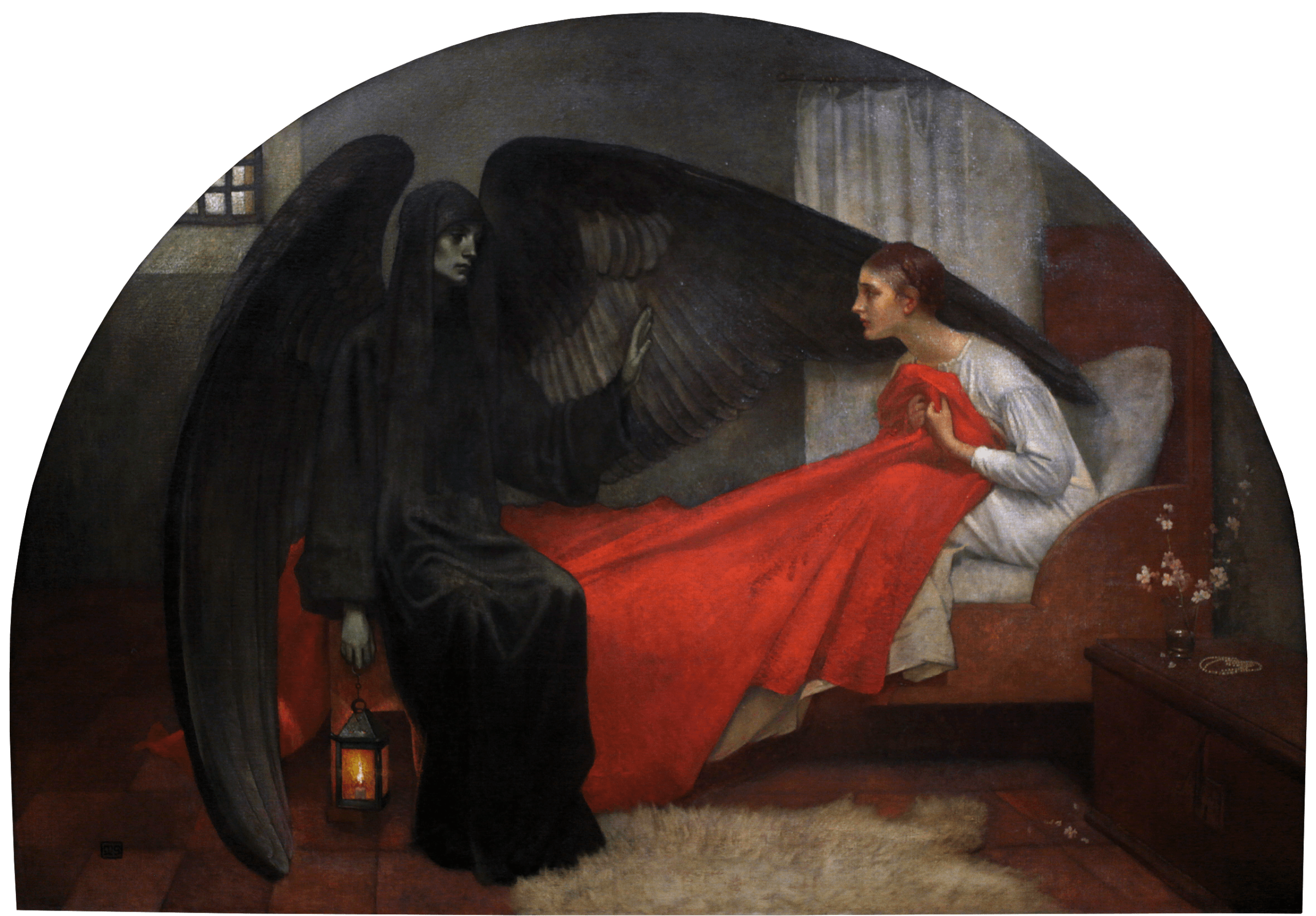
Marianne Stokes, Death and the Maiden, Musée d’Orsay, 1908
‘No dia seguinte ninguém morreu’ (The following day, no one died). Thus begins José Saramago’s novel As Intermitências da Morte (literally, ‘The Intermittences of Death’). People continue to get hurt and deteriorate; they just can’t die in the country where this novel is set. Quickly, the nation faces economic, political, and religious conundrums: without income, the funeral homes pivot their services to pets, which still die; hospitals and hospices run out of beds, as the terminally ill never leave; the church fears that, freed from the spectre of death, people will lose their faith and morals; the insurance companies mandate a metaphorical ‘death’ at 80 years of age – when policy holders could collect their own death benefits. Like many others in the novel, two members of a peasant family – a baby boy and a grandfather – would have already died if death were not on strike. Yet, the patriarch is the first character to whisper an unusual request: to smuggle him, as well as the baby, across the border. While carrying out his wish, the family formulates a key distinction: to take someone to death is not the same as killing them. As soon as they leave their country, grandfather and baby expire. When the surviving relatives return home, a neighbour confronts them and finds out that the ill can die across the border. The news spreads fast, creating national and international problems: people wrangle over the ethics of assisting in their relatives’ deaths, neighbouring countries close their borders, and the ‘maphia’ (spelled with ‘ph’ to distinguish it from the traditional mafia) cuts a deal with the government to keep smuggling the moribund as a way to alleviate the crisis. At some point, the director general of television receives a letter signed by ‘death’ (in lowercase), who claims that her death-suspension experiment failed and proposes a new deal: to warn people 7 days before they should die. The personal involvement of death triggers the existential second part of the novel, in which the Grim Reaper herself becomes infatuated with a cellist.
In 2005, Portuguese writer José Saramago claimed that all his novels – published before and after his 1998 Nobel Prize – flesh out the consequences of a surreal hypothesis (e.g. Blindness: what if we had a pandemic of blindness? Seeing: what if the blank vote won an election?). Yet, the guiding question of As Intermitências da Morte, written when Saramago was in his 80s, is grounded in the author’s own sense of mortality. Saramago said the idea for the book came to him on the eve of All Souls’ Day in 2004, as he considered our aging society: what are the implications of a longer life, how long would ‘old age’ be, how could we pay for pensions? Reviewers note the novel’s distinctive narrator, who is unusually preoccupied with the reaction of his readers and often intervenes to comment on the happenings, as if he were not in control of the story he is telling. The theme of control or agency bridges the literary and ethical discussions surrounding the book. Speaking to students of Ethics at a School of Medicine, Saramago highlighted the distinction between ‘matar’ (killing) and ‘dar a morte’ (giving death), echoing his characters. In a TV interview, he elaborated on that distinction, mentioning Ramón Sampedro (whose plea for euthanasia is dramatized in the film Mar Adentro) as an example of someone who asked to be given death – which would exempt an eventual assistant from any crime. This distinction of Saramago’s, as well as his novel, have been referenced repeatedly in legal contexts. In 2007, when a Brazilian judge blocked a 2006 resolution of the Federal Council of Medicine authorizing orthothanasia for terminal patients, a prosecutor remembered Saramago and his characters’ request to be given death. References to the novel continued to appear in legal discussions even after the Ministry reversed its opinion in 2010. In Portugal, Saramago’s kill-vs-give-death distinction was evoked by the Bloco de Esquerda party in the debate leading to the legalization of assisted dying in 2023 (Law 22/2023). Among interest groups that oppose assisted dying, the Catholic church has had a troubled relationship with Saramago’s work: breaking a long estrangement initiated in 1991 (when Saramago’s controversial novel The Gospel According to Jesus Christ was published), ten years after the writer’s death, the Vatican City newspaper L’Osservatore Romano published a positive re-evaluation of Saramago’s body of work; the reviewer cites As Intermitências da Morte and praises the compassion of the novelist’s characters – a testament to the far-reaching influence of Saramago’s portrayal of assisted dying.
Kurt Rohde (music) & Thomas Laqueur (libretto), ‘Death with Interruptions’, Left Coast Chamber Ensemble, UC Davis Music / YouTube
João Maria André (adaptation) & João Paulo Janicas (direction), ‘As Intermitências da Morte, Cooperativa Bonifrates
‘José Saramago sobre As Intermitências da Morte,’ RTP Ensina
[Dutch Translation] José Saramago, ‘Het verzuim van de dood’, tr. Maartje de Kort, Meulenhoff, 2013…

Alejandro Amenábar (director and writer), Mateo Gil (writer)
For almost thirty years, Ramón Sampedro has been paralysed from the neck down. Having had enough of his paraplegic state, Ramón decides that he wants to die and seeks the help of an assisted dying lobby group to generate support for his case. When all legal avenues fail, a small group of his friends help Ramón to end his life.
Ramón Sampedro
A collection of letters, poems, and essays, Ramón Sampedro’s ‘Cartas desde el infierno’ constitutes a philosophical treatise on the ethics of euthanasia. Written over decades – between the 1968 accident that left Sampedro tetraplegic and the 1996 first edition – the book became a landmark work on the right-to-die debate, influencing the 2021 legalization of assisted death in Spain.
Paolo Marinou-Blanco (director)
Gilda, a Brazilian immigrant in Portugal, has an inoperable cancer and wants to die. After various failed suicide attempts, she joins the sketchy group Joy Transition International and meets Amadeu, a young undertaker who also wants to die. Their search for a peaceful death is the plot of this comedy that ends in Spain, where a doctor is willing to bend the euthanasia bureaucracies for immigrants.