
© Lexica AI-model, Untitled artwork generated from the summary, 2024
78-year-old Richard Gärtner (Matthias Habich) lost his purpose in life after his wife Elisabeth died of a brain tumour three years ago. Although he is in the best of health, he wants to die with medical assistance. Following the recent ruling of the German Federal Constitutional Court, he does indeed have the right to seek assisted suicide as a healthy person. However, he has unsuccessfully tried to apply for a lethal dose of sodium pentobarbital at the Federal Institute for Drugs and Medical Devices, just as his family doctor rejected his request for assisted suicide. He thus turns to the German Ethics Council, which has to decide whether it is ethically justifiable for a doctor to help a healthy person die. In the council meeting, Mr Gärtner and his family doctor, Dr Brandt (Anna Maria Mühe), provide insight into his personal situation, allowing the viewers to learn about his existential suffering at the loss of his wife and his determination to die. In addition, three experts from the fields of law, medicine and theology are questioned on the subject of assisted dying, alternately by Dr Keller (Ina Weisse) from the Ethics Council, who rejects physician-assisted suicide, and Mr Gärtner's lawyer and friend Biegler (Lars Eidinger), who considers it a legitimate act of self-determination. The viewers are thus presented with arguments for and against assisted dying from different perspectives, which should enable them to make an informed judgement about Mr Gärtner's case. The film envisages that, at the end, the viewers will assume the role of the Ethics Council and decide on whether or not Mr Gärtner should receive the lethal drug.
GOTT is based on the play of the same name by Ferdinand von Schirach, who also wrote the screenplay. It sparked an enormous media response, mainly due to its topicality. Schirach wrote it at a time when physician-assisted suicide was prevented by Section 217 of the German Penal Code (2015). Several constitutional complaints were pending against it, so Schirach, who is also a lawyer himself, deliberately chose a topic where there was a need for clarification. Unexpectedly, however, GOTT gained further relevance before its publication when the Federal Constitutional Court declared Section 217 ‘null and void‘ in February 2020. The Court ruled that ‘the general right of personality encompasses a right to a self-determined death, which includes the right to suicide‘ as well as ‘the freedom to seek and, if offered, make use of assistance provided by third parties for this purpose.' And this right, the Court further stated, ‘is in particular not limited to serious or incurable illness.‘ Following this judgement, it is up to the Bundestag to pass new legal regulations. Schirach also adapted his film specifically to the ensuing debate. The great attention the film received was especially due to the fact that it was first broadcast simultaneously on flagship national television channels in both Germany and German-speaking Switzerland. This took place within the framework of a theme night on assisted suicide, where the film was subsequently discussed, and the viewers were given the opportunity to vote on the Gärtner case—just like in the theatres. In Germany, 70.8% of the viewers voted for the protagonist’s right to die; in Switzerland, 67.6% were in favour. However, the film also met with fierce criticism from theology and medicine. Various representatives accused Schirach of presenting the subject of assisted suicide in an overly one-sided and approving manner and criticised above all the negative portrayal of the characters who spoke out against it.
Suggested Citation: GOTT von Ferdinand von Schirach, Assisted Lab: A Digital Cultural Archive on Assisted Dying, 18 March 2024 <link>

Ferdinand von Schirach
After the death of his wife, 78-year-old Richard Gärtner wants to end his life by assisted suicide, although he is in perfect health. In the form of a meeting of the German Ethics Council, the play questions whether it is ethically justifiable for a doctor to help a healthy person take their own life and lets the audience vote on it.
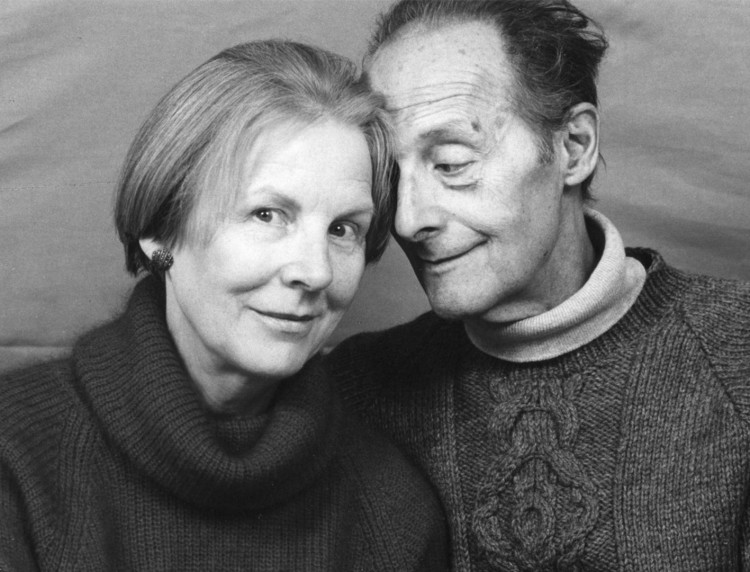
André Gorz
The social philosopher André Gorz cared for his ill wife Dorine for two decades. In 2007, they took their own lives together. A year earlier, Gorz had published a narrative public love letter to his wife which was subsequently read by both the media and assisted dying interest groups as a farewell letter and explanation of their motivation for suicide.

Roswitha Quadflieg
Roswitha Quadflieg’s novel tells the story of Paul Gärtner who, in his mid-seventies and reliant on a wheelchair after battling cancer, records his life story and advocates for the right to access sodium pentobarbital for those seeking to end their lives on their own. The novel was received with praise from advocacy groups in Germany and Switzerland.

Sumira Roy (Director)
This quiet documentary displays the daily lives and material reality of octogenarian couple Narayan and Iravati Lavate who rose to prominence in 2018 for their plea to die by state-sanctioned euthanasia despite being physically and mentally healthy. The film humanizes Narayan and Iravati, showing the legal, societal and ethical resistance to their desire to “die with dignity.”